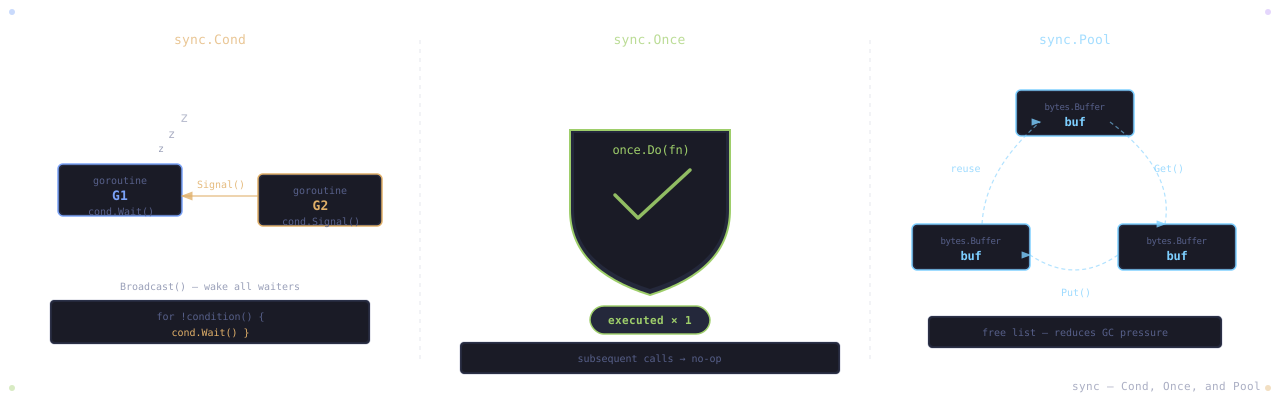
The previous article covered the most commonly used sync primitives: WaitGroup for goroutine coordination and Mutex/RWMutex for protecting shared state. The sync package also provides three more specialized tools — Cond, Once, and Pool — that solve narrower but recurring problems in concurrent programs. Each addresses a situation where the general-purpose primitives either don't fit or would require awkward workarounds.
sync.Cond
A sync.Mutex is useful when you want to protect a critical section. But sometimes the problem is different: a goroutine needs to wait not just for exclusive access, but for a condition to become true — for example, waiting until a queue has items, or until a flag is set.
The naive approach is to poll in a loop:
This wastes a CPU core. A slightly better version uses time.Sleep inside the loop, but it still polls at a fixed interval and introduces artificial latency.
sync.Cond provides the right abstraction: a goroutine can sleep until it is explicitly woken by another goroutine that knows the condition has changed.
Structure
A Cond is created with sync.NewCond, which takes a sync.Locker — typically a *sync.Mutex or *sync.RWMutex:
The three methods on Cond are:
| Method | Description |
|---|---|
Wait() | Atomically unlocks the mutex and suspends the goroutine. Reacquires the lock before returning when woken. |
Signal() | Wakes one goroutine waiting on this Cond. |
Broadcast() | Wakes all goroutines waiting on this Cond. |
The critical rule: Wait must always be called inside a for loop, not an if statement:
The loop is necessary because of spurious wakeups: Wait may return without Signal or Broadcast having been called. The loop re-checks the condition and sleeps again if it is still false. This pattern is standard for condition variables across all languages.
Example: producer and consumer
The consumer calls Wait, which atomically releases the lock and suspends. The producer acquires the lock, appends to the queue, calls Signal to wake one waiting goroutine, and releases the lock. The consumer wakes up, reacquires the lock, finds the queue non-empty, and processes the item.
Use Signal when only one waiting goroutine needs to be woken and can handle the changed condition alone. Use Broadcast when all waiters need to re-evaluate — for example, when a shared resource becomes available and multiple goroutines are competing for it.
Channels are often simpler
For basic producer/consumer patterns, a buffered channel is usually more idiomatic Go. sync.Cond shines when the condition is more complex than "a value is available" — for example, waiting until a counter exceeds a threshold or until multiple independent conditions are all true simultaneously — where encoding that logic into a channel would require awkward coordination.
sync.Once
sync.Once ensures that a function runs exactly once, regardless of how many goroutines call it concurrently. After the first call completes, all subsequent calls are no-ops.
The entire API is a single method:
Do is thread-safe. If multiple goroutines call Do at the same time, exactly one executes the function; the others block until it returns. Once the function has returned, all future calls to Do return immediately without re-executing.
Uses
Lazy initialization is the primary use case. Rather than initializing a resource at package load time — which incurs cost even if the resource is never needed — you initialize it on first use:
The connection pool is created only the first time getDB is called — and only once, no matter how many concurrent callers arrive simultaneously. Every subsequent call returns the same *sql.DB instance.
Panics inside Do are not retried
If the function passed to Do panics, Once still considers the call to have executed. Future calls to Do will not retry the function. If initialization can fail and you need retry capability, manage that logic yourself rather than relying on Once.
Package-level initialization is another common use, particularly for test helpers or optional features that are expensive to set up. Once gives you the safety of init() — it runs only once — with the laziness of on-demand initialization — it runs only when first needed.
sync.Pool
A sync.Pool is a thread-safe free list: a pool of objects that can be saved and reused rather than allocated and garbage-collected on every use.
In programs with high request throughput — HTTP servers, parsers, encoders — many short-lived objects are allocated and freed in rapid succession. Each allocation adds pressure on the garbage collector. A Pool lets you recycle these objects instead of continuously creating new ones, reducing GC overhead and improving sustained throughput.
Structure
The New field is a factory function called when Get needs an object and the pool is empty. If New is nil and the pool is empty, Get returns nil.
The two methods are:
| Method | Description |
|---|---|
Get() | Retrieves an object from the pool. Calls New if the pool is empty. Returns any. |
Put(x any) | Returns an object to the pool for future reuse. |
Example: buffer pool for encoding
A common pattern is pooling bytes.Buffer objects for JSON encoding in a hot path:
Get retrieves a buffer from the pool (or allocates one if the pool is empty). After resetting it with buf.Reset(), the buffer is used for encoding. defer bufPool.Put(buf) returns the buffer to the pool when the function exits, making it available for the next call.
Under sustained load, the pool reaches a steady state where buffers cycle between in-use and available, with few new allocations needed. This is why sync.Pool is used internally by the Go standard library's fmt and encoding/json packages.
How the pool works
Internally, Pool maintains a per-P (per-processor) local list. Put stores the object in the current goroutine's P's local slot. Get checks the local slot first, then steals from other Ps, then calls New.
The Go garbage collector may clear the pool at any collection cycle. Objects in the pool are not shielded from GC. This is by design — Pool is a performance optimization, not a persistent store. Programs must be prepared for the pool to be empty at any point.
Pool is not a connection pool
sync.Pool is designed for objects that are cheap to recreate and safe to discard — byte buffers, temporary slices, scratch structs. Do not use it for objects that hold OS-level resources such as network connections, file descriptors, or goroutines. If the GC clears the pool, those resources are leaked, not reused. Use a dedicated connection pool — like database/sql's built-in pool — for OS-backed resources.
What this means in practice
sync.Cond, sync.Once, and sync.Pool each solve a specific problem that WaitGroup and the mutex family leave uncovered.
Use Cond when a goroutine needs to sleep until a condition that another goroutine will signal — especially when the condition is more nuanced than receiving a value from a channel.
Use Once for lazy, thread-safe initialization of resources that are expensive to create or that must exist as exactly one instance.
Use Pool to reduce per-operation allocation overhead in throughput-sensitive paths, accepting that the pool may be cleared by the GC at any time.
Together, the six primitives in this pair of articles — WaitGroup, Mutex, RWMutex, Cond, Once, and Pool — give you a complete toolkit for the most common coordination and memory-management challenges in concurrent Go.